Naturepedic vs. Conventional Mattresses: What’s Actually In Yours?
They look identical — a rectangle with a quilted top. The difference is entirely on the inside, and the inside is the whole point: one is built from petroleum, a mystery fire barrier and forever chemicals; the other from cotton, wool and latex you could practically compost. Here’s the layer-by-layer breakdown — and whether the organic one is actually worth the bigger number.
♥︎ Affiliate Disclosure: This post contains affiliate links. If you shop through them, I may earn a small commission at no extra cost to you. Your support keeps Clean AF Life thriving — endlessly appreciated.
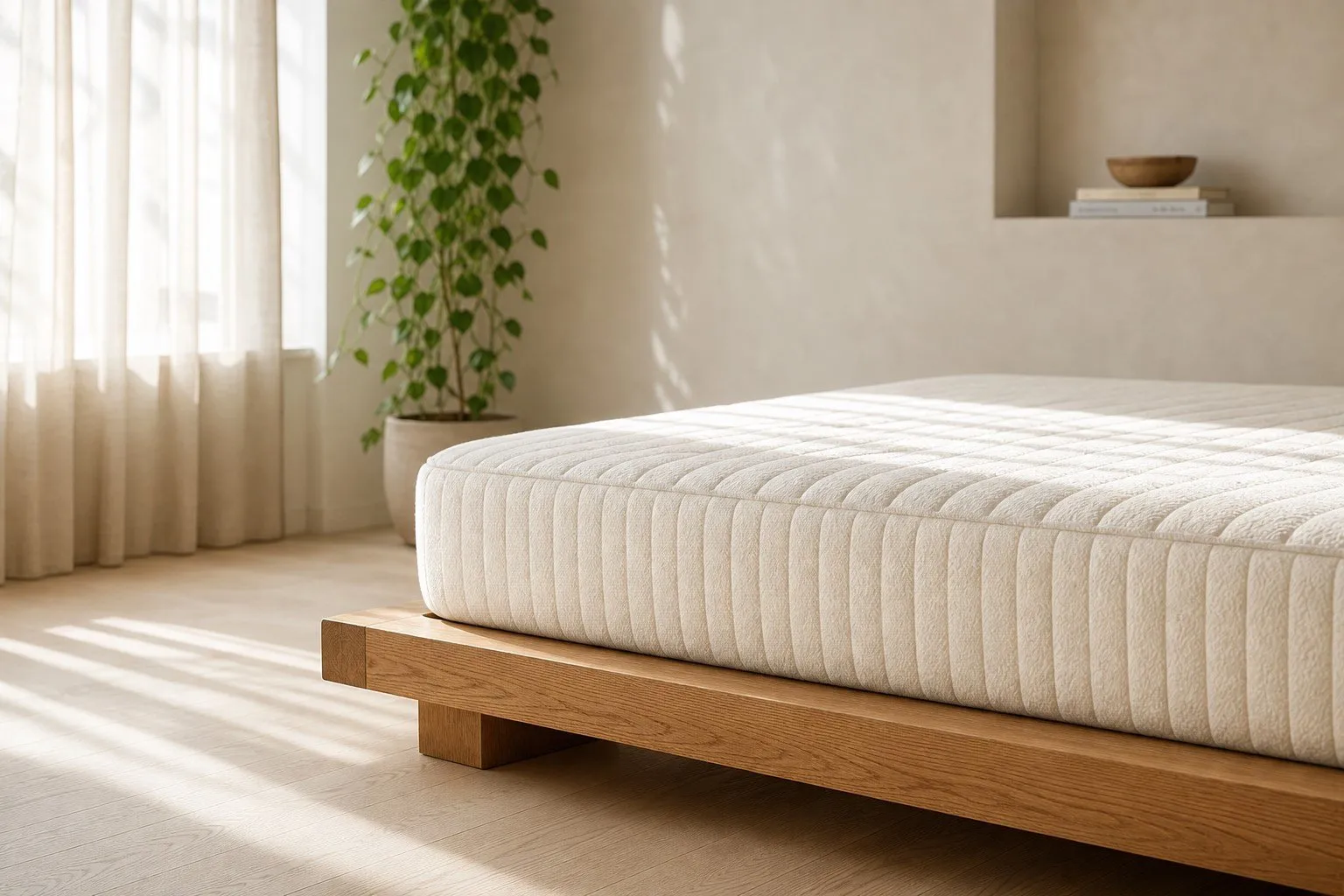
Put a Naturepedic vs conventional mattress side by side and you genuinely cannot tell them apart. Same rectangle, same quilted top, same zip-up cover. Which is exactly the problem — because everything that matters is sealed on the inside where you’ll never look, and the two insides could not be more different.
You’ve probably already accepted that the average mattress is a bit of a chemistry set. (If you haven’t, that’s the deep dive over here — go get angry, then come back.) This is the next question, the one you ask right before you actually spend money: how different is the clean option, really — and is it worth two to three times the price of a bed-in-a-box? Let’s put them in the ring.
And for the record, none of this is a vibes ranking: I went through the actual certifications, the third-party lab tests, real owner reviews, and the recall and lawsuit records before picking a side.
⏱️ The 60-Second Verdict
Conventional: polyurethane foam that off-gasses VOCs, a fire barrier that’s often fiberglass or chemical retardants, and frequently a PFAS “waterproof” finish. Naturepedic: organic cotton, organic wool and GOLS organic latex — wool is the fire barrier — with zero polyfoam, zero fiberglass, zero formaldehyde glue and zero PFAS, backed by the strongest certification stack in the industry. Worth it? If it’s in the budget, yes — you sleep on this thing ~3,000 hours a year for a decade. If you can’t right now, start with the cheaper swaps in the bedroom overhaul and save toward the mattress.
Naturepedic vs Conventional Mattress, on One Chart
Before we go layer by layer, here’s the whole Naturepedic vs conventional mattress comparison in one place, attribute by attribute:
| Layer | Conventional Mattress | Naturepedic |
|---|---|---|
| Comfort layer | Polyurethane / memory foam (petroleum; off-gasses VOCs) | GOLS-certified organic latex |
| Fire barrier | Often fiberglass or chemical flame retardants (e.g. TCEP) | Organic wool — naturally flame-resistant, nothing added |
| Cover | Synthetic blends, sometimes treated finishes | GOTS-certified organic cotton |
| Waterproofing | Frequently PFAS “forever chemical” coating | None — validated non-detectable PFAS |
| Adhesives | VOC-emitting glues holding layers together | Glueless — a custom no-adhesive construction |
| Certifications | Usually CertiPUR-US (foam only, industry-funded) | GOTS + GOLS + GREENGUARD Gold + MADE SAFE + EWG Verified |
| Off-gassing | Strong at first, low-level for the life of the bed | Minimal — no polyfoam to off-gas |
| Price | Cheap upfront — and it shows | An investment, built to last a decade+ |
Now the parts worth slowing down on.
What’s Actually in a Conventional Mattress
I did the full forensic teardown in the toxic-mattress deep dive, so here’s the speed round. A conventional bed-in-a-box is basically three problems stacked on top of each other:
- Polyurethane foam. Petroleum in solid form. It off-gasses VOCs — formaldehyde, benzene, toluene — hardest when new, then quietly for the rest of its life. Your body heat speeds it up, so congratulations, you’re the diffuser.
- A mystery fire barrier. To pass the federal open-flame standard, cheap mattresses wrap the foam in something flame-resistant. Too often that’s fiberglass (the stuff that escapes when someone unzips the cover and contaminates the entire house) or a chemical flame retardant like TCEP.
- A PFAS finish. Lots of “waterproof” and stain-resistant treatments are forever chemicals — frequently on the very protector you bought to keep the thing clean.
The kicker: you can’t tell any of this from the outside. The label says “memory foam,” slaps a “CertiPUR-US” logo on the box, and calls it a day. Which brings us to the other corner.
What’s in a Naturepedic
Same teardown, but for a mattress built by people who clearly read the same horror stories you did. A Naturepedic is the conventional mattress with every problem material swapped for something you could, in theory, compost:
- GOLS-certified organic latex where the polyfoam would be — springy, durable, and not descended from a barrel of crude oil.
- Organic wool as the fire barrier. Wool is naturally flame-resistant, so it passes the same federal burn test with nothing sprayed on it. No fiberglass. No TCEP. No mystery sock.
- GOTS-certified organic cotton cover, and no PFAS — validated non-detectable, not just “we didn’t add any.”
- No glue. The sleeper detail (pun fully intended): most mattresses, even good organic ones, are held together with adhesives. Naturepedic uses a custom glueless build. No VOC-emitting glue lines, full stop.
And here’s what separates a real clean mattress from a “natural”-on-the-label one — the certification stack. Naturepedic carries the whole thing:
🏅 The Cert Stack (What You’re Actually Paying For)
GOTS (organic cotton & wool) + GOLS (organic latex) tell you what it’s made of. GREENGUARD Gold tells you what comes out (emissions). MADE SAFE and EWG Verified screen the whole product against thousands of banned substances — Naturepedic was the first mattress brand to earn EWG Verified — plus UL validation for formaldehyde-free and non-detectable PFAS. That’s what’s-in-it, what-comes-out, and banned-list coverage in one bed. A lone “CertiPUR-US” badge (foam only, funded by the foam industry) is not that.
But Is It Actually Worth It?
Let’s deal with the elephant: on price, a Naturepedic vs conventional mattress is several times what a throwaway bed-in-a-box costs. So is it worth it? Here’s the honest math — including the parts that aren’t flattering.
The case for yes: you sleep on this thing roughly 3,000 hours a year for a decade. Spread the cost over ten years of nightly use and it works out to pennies a night to not breathe petroleum and fiberglass in your sleep. Meanwhile people cheerfully drop a small fortune on a “luxury” foam mattress still built on polyurethane and a mystery barrier — so next to that, a certified-organic bed isn’t the splurge. It’s the sane option — and the cleanest place to start is the Naturepedic organic lineup itself.
And the risk is smaller than the price tag makes it feel. Naturepedic backs every adult mattress with a 100-night trial and free returns — and on the EOS, you can swap individual layers for free within that window if the firmness isn’t quite right, so you’re not gambling thousands on a single guess. Behind that sits a 25-year warranty. You’re not stuck with the wrong bed, and you’re not buying another one in five.
The honest cons (because pretending there aren’t any is how you lose people):
- It’s a real chunk of money up front. No spin around that. If it’s not happening right now, genuinely fine — work the cheaper swaps in the bedroom overhaul and save toward the mattress.
- The EOS transfers more motion than average (the latex-and-coil tradeoff) — worth knowing if you share a bed with a world-class fidgeter.
- Some models run firm. The fix is built in — the EOS dials firmness, each side separately, which most beds can’t.
None of that’s a dealbreaker. It’s just the difference between “bought it because an ad told me to” and “read the cons and bought it anyway.”
Start Living Low Tox
Sign up for occasional low tox inspo, honest reviews, non-toxic swaps, and helpful picks for a healthier home and lifestyle.
Which Naturepedic Is Right for You
Three real choices (the luxury Halcyon is in-store-only and priced like a gently-used sedan, so I’ll spare you):
- Serenade — the accessible entry. Latex over coils, three firmness options, zero fuss. The “I just want the clean mattress without a spreadsheet” pick.
- EOS Classic — fully customizable, and each side adjusts independently. The couples’ peace-treaty bed: you like a cloud, they like a plank, nobody consults a lawyer.
- EOS Trilux & Pillowtop — all-latex or plush-top upgrades if you want to splurge on feel.
Organic cotton, organic wool, and GOLS organic latex — zero polyurethane foam, zero fiberglass, zero chemical flame retardants, zero glue. GOTS, GOLS, GREENGUARD Gold, MADE SAFE, and EWG Verified. Start with the Serenade or customize each side with the EOS. The bed you finally stop thinking about at 2 a.m.
Shop Naturepedic →Naturepedic vs. Avocado
If you’ve spent more than four minutes researching organic mattresses, you’ve met Avocado — the green one with the gorgeous branding that owns the entire first page of Google. Credit where it’s due: Avocado is genuinely, certifiably clean. Six legit certifications, real organic materials, no greenwashing. I’m not going to pretend otherwise.
But “clean” and “the one I’d actually buy” aren’t the same sentence — and on the spec sheet, Naturepedic quietly pulls ahead:
- Glue. Avocado holds its layers together with an adhesive (an “eco” one, but still glue). Naturepedic is glueless. When you’re paying for clean, “none at all” beats “a nicer kind.”
- Durability. Avocado’s most common knock from real owners is sagging and body impressions after 3–4 years — rough for a premium bed. Naturepedic’s entire pitch is longevity, and you can swap individual layers instead of buying a whole new bed.
- Couples. Avocado gives you one firmness for the whole mattress. The Naturepedic EOS customizes each side.
And the tell? I wrote a whole honest breakdown of Avocado — and even that post ends up pointing at Naturepedic as the long-term pick. Same starting price, same cert tier, but only one of them is built to still be holding you up in year eight — the Naturepedic organic mattress I’d put my money on.
The Bottom Line
Put a Naturepedic vs conventional mattress side by side and they look identical, and they could not be more different where it counts: one is petroleum, a mystery fire barrier, and forever chemicals; the other is cotton, wool, and latex with the receipts to prove it. The clean one costs more up front and pays you back with a decade of not marinating in VOCs — at roughly the price of a weekly coffee.
Worth it? For the one piece of furniture you spend a third of your life pressed against, breathing — yeah. This is the place to do it right.
Want the whole clean-sleep setup, not just the mattress? It’s all in the bedroom overhaul.
Sleep clean. — Me ♥︎
Frequently Asked Questions
Is Naturepedic worth the money?
If it’s in the budget, yes — for the one thing you spend ~3,000 hours a year on, it works out to pennies a night over a decade to skip polyurethane foam, fiberglass, and PFAS. The honest caveat: it’s a real upfront cost, so if it’s not in the budget yet, start with cheaper swaps and save toward it.
Naturepedic vs conventional mattress: what’s the real difference?
Materials. A conventional mattress is petroleum-based polyurethane foam with a fiberglass or chemical fire barrier and often a PFAS waterproof finish. A Naturepedic swaps all of it for GOLS organic latex, organic wool as a natural flame barrier, GOTS organic cotton, and no glue — backed by GOTS, GOLS, GREENGUARD Gold, MADE SAFE, and EWG Verified.
Does a Naturepedic mattress off-gas?
Minimally. There’s no polyurethane foam to off-gas VOCs, so owners typically report little to no chemical smell. Natural latex has a faint, non-toxic scent that fades fast — nothing like the “new mattress smell” of a foam bed.
Is Naturepedic better than Avocado?
Both are genuinely certified-clean and start around the same price, so it’s close. Naturepedic edges ahead on three things: it’s fully glueless (Avocado uses an adhesive), it has a stronger durability reputation (Avocado’s common knock is sagging after 3–4 years), and the EOS lets couples customize each side. Avocado’s a fine bed — Naturepedic is the longevity play.
Should I get the Serenade or the EOS?
Get the Serenade if you want a straightforward clean mattress and a set firmness suits you. Get the EOS if you’re a couple who can’t agree on firmness, or you want to fine-tune feel and swap layers over time. Both use the same certified-organic materials.
What certifications should a non-toxic mattress have?
Look for a stack, not a single badge: GOTS (organic cotton/wool) and GOLS (organic latex) for materials, GREENGUARD Gold for low emissions, and a whole-product screen like MADE SAFE or EWG Verified. Be skeptical of a lone CertiPUR-US logo — it only covers the foam and is funded by the foam industry.