Why Your “Nonstick” Pan Is Probably
Still Coating Your Food in PFAS
PFOA-free isn’t PFAS-free. Learn how to decode cookware marketing, spot the shell game hiding in plain sight, and find PFAS-free cookware that’s actually worth your money.
♥︎ Affiliate Disclosure: This post contains affiliate links. If you shop through them, I may earn a small commission at no extra cost to you. Your support keeps Clean AF Life running — and the rabbit holes well-funded.
The nonstick pan was invented so food wouldn’t stick. The irony is the chemicals they used to make that happen are now permanently stuck — in your blood, your drinking water, and your cat. PFAS (per- and polyfluoroalkyl substances) have been found in over 97% of Americans’ bloodstreams. They don’t break down. They accumulate. And for decades, the cookware industry put them on everything.
Here’s the part that really gets me: most people who have already “made the switch” to safer cookware are still using pans with PFAS in them. Because the industry figured out that if they just changed the label, nobody would notice. Spoiler: I noticed.
What PFAS Actually Are
PFAS stands for per- and polyfluoroalkyl substances. They’re a family of more than 15,000 synthetic chemicals — all built around an extremely strong carbon-fluorine bond. That bond is what makes them slick, heat-stable, water-resistant, and grease-repellent. It’s also what makes them effectively indestructible.
“Forever chemicals” is the nickname, and it’s not hyperbole. PFAS don’t meaningfully break down in the environment or in your body. They bioaccumulate — meaning the longer you’re exposed, the higher the concentration in your blood and tissue over time.
What the Research Actually Says
The EPA and NIH have linked PFAS exposure to a growing list of health concerns. According to the EPA’s PFAS overview, these include thyroid disruption, immune system suppression, interference with hormones and reproductive function, elevated cholesterol, and certain cancers — particularly kidney and testicular cancer. The NIH’s National Toxicology Program has also flagged PFAS as presumed to cause cancer in humans based on available evidence.
None of this is fringe-wellness-blog territory. This is federal agency territory. The research is there. The industry just really hoped you were too busy to read it.
The Banning Problem
PFOA — the original Teflon chemical — was phased out by 2013. PFOS was banned earlier. But PFAS is a family of 15,000+ compounds. Banning two of them and calling it fixed is like banning one specific flavor of cigarette and saying tobacco is solved. The replacements are often just as fluorinated — and just as untested.
The PTFE vs. PFAS Shell Game
Here’s where it gets deliberately confusing — and I say “deliberately” because the language did not get this convoluted by accident.
PTFE (polytetrafluoroethylene) is the slippery polymer that makes nonstick surfaces nonstick. You know it by the brand name Teflon. And yes — PTFE is itself a PFAS compound. It’s made using fluorinated chemistry. The pan you switched to because the box said “PFOA-free” is, in most cases, still a PTFE pan. You didn’t leave the PFAS family. You just moved to a different cousin.
The “PFOA-Free” Problem
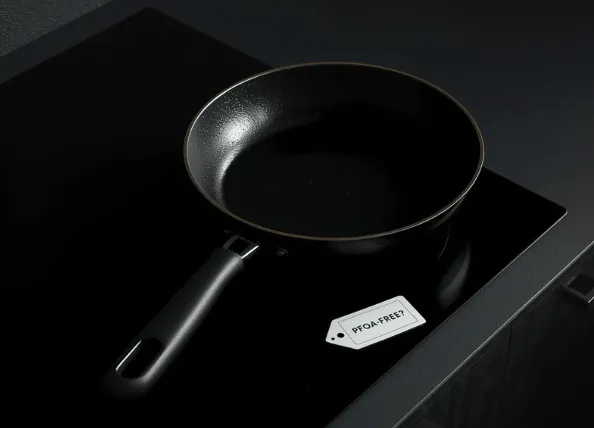
“PFOA-free” became the industry’s favorite two-word magic trick after PFOA was banned. Slap it on the box, print it big, and let consumers assume the problem is solved. It isn’t. PFOA-free just means they stopped using that one specific compound. The replacement chemicals — like GenX (HFPO-DA), developed by Chemours — are also fluorinated, also synthetic, and currently under EPA investigation for their own set of health concerns. The EPA has flagged GenX as a possible carcinogen. So: banned the bad thing, replaced it with a possibly-also-bad thing, put “PFOA-free” on the label. Great work, everyone.
The HexClad Update Worth Knowing
HexClad is a good example of why you need to verify current status before citing any brand. Old reviews called HexClad PTFE-coated — and they were right at the time. HexClad switched from PTFE to their proprietary TerraBond™ ceramic coating in 2024, following a class action lawsuit. If you’re reading old content about HexClad anywhere (including on this site — I update, but the internet is forever), check the current product specs directly on their site before making a decision. The pre-2024 pans and the current pans are different products.
💡 Rule of Thumb
If a brand won’t tell you exactly what their coating is made of — the actual chemistry, not a brand name — that’s your answer. Transparency isn’t hard. Opacity is a choice.
Start Living Low Tox
Sign up for occasional low tox inspo, honest reviews, non-toxic swaps, and helpful picks for a healthier home and lifestyle.
How to Actually Read a Pan’s Safety Claims
The cookware marketing lexicon is a carefully constructed funhouse mirror. Every claim sounds reassuring. Most of them mean almost nothing. Here’s the actual translation:
Tells you nothing about what creates the nonstick surface. Could be PTFE, ceramic, or something else entirely. It is a function description, not a safety claim.
They stopped using one specific banned PFAS compound. The coating may still contain other PFAS chemicals, including fluorinated replacement compounds like GenX. Minimum legal compliance dressed up as a selling point.
This is the claim you actually want. But demand third-party documentation. Any brand can print it on a box; few can back it up with independent testing or transparent material disclosure.
Generally safer, but “ceramic” is a broad category. True sol-gel ceramic coatings are fluorine-free. “Ceramic-reinforced PTFE” is PTFE with a ceramic-sounding name. Not the same thing. Check which one you are actually buying.
No coatings. No ambiguity. No fluorinated chemistry anywhere in the conversation. These are what they are, and what they are is fine.
The Sol-Gel Ceramic vs. “Ceramic-Reinforced PTFE” Distinction
This one trips people up constantly. True ceramic coatings — like those used by GreenPan, Caraway, and Our Place — are made via a sol-gel process that uses silica (silicon dioxide) as the base. No PTFE. No fluorinated anything. “Ceramic-reinforced PTFE,” on the other hand, is a PTFE coating with ceramic particles mixed in for durability. The ceramic is essentially cosmetic. The base is still Teflon. The box will not make this distinction obvious. You have to look it up.
The PFAS-Free Cookware Brands That Actually Make the Cut
Short version: I’m not turning this into a full product breakdown here — that’s what the Non-Toxic Cookware Shop page is for. But here are five picks worth knowing, with the one-liner on each.
Sol-gel ceramic coating, PTFE-free, PFAS-free, lead-free, cadmium-free. Releases 60% fewer VOCs than traditional nonstick during cooking, per their own testing. Actually pretty. Comes with magnetic pan racks so you don’t destroy your cabinets.
Compare Ceramic Picks →Thermolon Minerals ceramic coating — no PFAS, no PFOA, no lead, no cadmium. Doesn’t release toxic fumes if you accidentally overheat it. Wide availability, good price point, solid everyday performer.
See the One I Use →Made in Tennessee, 5-ply construction, titanium-strengthened 316Ti stainless interior — one of the few stainless lines that actively resists leaching. No coatings, no ambiguity, made by people who will actually answer questions about their materials.
Compare Stainless Picks →Cast iron. That’s the whole pitch. No coating to chip, no chemistry to question, lasts multiple generations if you don’t abuse it. A Lodge skillet will outlive you and your opinion of it.
Compare Cast Iron Picks →Carbon steel gets nonstick as it seasons, like cast iron — but it’s lighter and heats faster. Matfer Bourgeat is French, professional kitchen-grade, and makes zero claims that require a fact-checker. Pure steel. That’s it.
Compare Carbon Steel Picks →For the full vetting breakdown on each — materials, certifications, where they’re manufactured, and what questions to ask before you buy — head to the Non-Toxic Cookware Shop page.
What to Do With Your Current Pans
Before you rip every pan out of your cabinet and hurl them into the yard: breathe. A measured transition is smarter than a panic purge — for your wallet, your stress levels, and honestly, the environment. Throwing away pans and buying all-new ones has its own footprint.
Stop Using These Immediately
- Scratched or chipped nonstick pans. This is the non-negotiable one. Once the coating is damaged, it’s actively releasing particles into your food. A scratched nonstick pan is a retired nonstick pan. No exceptions.
- Nonstick pans over high heat. PTFE coatings start to degrade around 500°F (260°C) and become genuinely dangerous above that. If you’re searing or using a burner on max, use stainless or cast iron.
- Nonstick in the oven. Oven temps vary wildly and are harder to control. Don’t risk it.
Your Transition Plan (That Won’t Destroy Your Budget)
- Start with the pan you use most. For most people, that’s a 10″ or 12″ skillet. Replace that one first — it’ll do the most good fastest.
- Add a stainless sauté pan next. It’s the most versatile piece in a kitchen and transitions well once you get the hang of preheating properly.
- Let your existing pans retire naturally — except the scratched ones (those go now). When a pan wears out or you’d replace it anyway, upgrade to something cleaner.
- Cast iron and carbon steel are a one-time purchase. Budget for them once and you’re done — forever.
💡 The Real Talk
Stainless and cast iron have a learning curve. Food will stick until you figure out the heat management. That’s not a failure — it’s a skill. Give yourself two weeks of actual cooking with it before deciding you hate it. You won’t hate it.
The cookware industry spent decades selling convenience and calling it safety. You don’t have to keep buying it. Literally.
Ready to see exactly what’s worth buying? The full vetted list — with sourcing notes, certifications, and my actual opinion — lives in the Non-Toxic Cookware Shop. And if you’re doing a full kitchen and home detox, the Cleaning Products page and Laundry page are your next stops.
— Me ✌︎