What Does Non-Toxic Mean on a Label? (Hint: Legally, Nothing)
What does non-toxic mean? Whatever the brand wants it to — there are zero rules. Here’s why the label is basically meaningless and which certifications actually have standards.
♥︎ Heads up: This post contains no affiliate links — it’s purely informational. I just want you to know what you’re actually looking at when you shop.
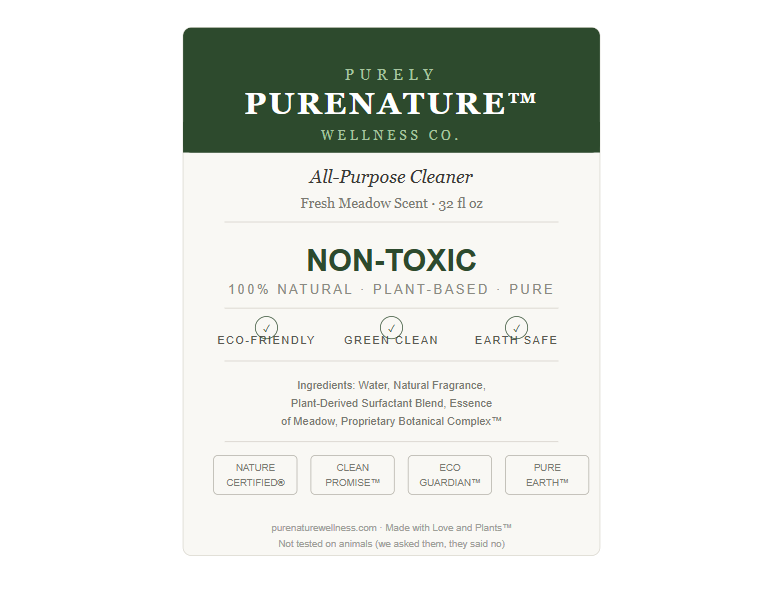
You pick up a cleaning spray. It says “non-toxic” in big friendly letters. Maybe there’s a leaf on it. You feel good about it. You buy it.
Here’s the thing: that label means absolutely nothing. Not “a little misleading.” Not “open to interpretation.” Nothing. The FDA doesn’t regulate it. The EPA doesn’t regulate it. There is no legal definition, no required testing, no oversight, no accountability. A company can print “non-toxic” on a bottle of drain cleaner and face zero legal consequences for doing so.
Welcome to the completely unregulated world of product marketing, where words like “natural,” “clean,” “green,” “pure,” and “non-toxic” are essentially just vibes.
The Label Tells You Nothing
This isn’t a conspiracy theory — it’s just how U.S. product regulation works, which is to say: it mostly doesn’t. Unlike the EU, which operates on a precautionary principle (ban first, ask questions later), the U.S. puts the burden of proof on consumers to figure out what’s actually in their products after the fact.
The result is a market where “non-toxic” has become a premium aesthetic. It’s a font choice. It’s a color palette. It signals that a brand is targeting a certain kind of buyer without having to actually do anything to earn the label.
The actual definition
The Consumer Product Safety Commission has a technical definition of “non-toxic” for household products — but it only applies to acute toxicity (i.e., will it kill you right now). It says nothing about long-term exposure, hormone disruption, carcinogens, or cumulative effects. So a product can technically pass the bar and still be full of ingredients you’d rather not have in your home for the next 20 years.
Greenwashing — slapping eco-friendly language on products that don’t deserve it — is one of the most effective marketing strategies of the past decade. Because it works. People want to make better choices, and marketers know that. The gap between what the label implies and what the product contains is where a lot of brands live.
The “Fragrance” Loophole Is Its Own Problem
While we’re here: “fragrance” (or “parfum”) on an ingredient list is a legal trade secret. A single entry can represent dozens or hundreds of individual chemical compounds that manufacturers are not required to disclose. Phthalates — endocrine disruptors linked to hormonal issues — are commonly used in fragrance formulations and don’t have to appear on the label.
This is true even on products that say “non-toxic” or “natural.” Unless a brand explicitly states their fragrance is phthalate-free and fully disclosed, you have no idea what’s in it. Some brands do disclose — that’s your signal that they’re actually trying.
Quick Check
See “fragrance” or “parfum” on an ingredient list of a product claiming to be clean? Look up the brand on the EWG Skin Deep database or check if they’re registered with SmartLabel.org. It takes two minutes and tells you more than the front of the bottle ever will.
Certifications That Actually Mean Something
The antidote to marketing language is third-party verification. These certifications have actual standards, actual audits, and actual consequences for non-compliance. None of them are perfect, but all of them require more than a graphic designer and a good font.
A nonprofit-run certification that screens products against a database of known harmful chemicals — including carcinogens, endocrine disruptors, neurotoxins, and reproductive toxins. They evaluate the full formulation, not just individual ingredients in isolation. One of the most rigorous certifications in the consumer product space.
Worth looking for: Yes — especially for personal care and household cleaners.The gold standard for organic textiles. Covers the entire supply chain from fiber to finished product, including dyes, processing chemicals, and manufacturing conditions. Requires at least 70% certified organic fibers, with the most stringent tier requiring 95%+. If you’re shopping for sheets, a mattress, or anything that sits against your skin for hours, GOTS certification is the one to look for.
Worth looking for: Absolutely — for anything textile.Tests every component of a textile product — including thread, buttons, and zippers — for harmful substances. It’s not the same as GOTS (which certifies organic farming practices), but it does certify that the finished product is free from a long list of regulated and non-regulated harmful substances. Common on bedding, towels, and clothing from mainstream brands that haven’t gone fully organic.
Worth looking for: Yes — especially when GOTS isn’t available.The nonprofit NSF certifies water filters against specific contaminant reduction claims. NSF 42 covers aesthetic contaminants like chlorine and taste. NSF 53 covers health-related contaminants including lead and VOCs. NSF 58 covers reverse osmosis systems. NSF 177 covers shower filters. NSF 401 covers emerging contaminants like pharmaceuticals, PFAS, and pesticides. Cross-check the exact model number in the NSF database — certification on one product does not mean the whole brand is certified.
Worth looking for: Yes — non-negotiable for water filters. NSF 53 + 401 is the combo to look for.The Environmental Working Group’s verification program requires full ingredient disclosure, no ingredients of concern from their database, and transparent manufacturing practices. Their free Skin Deep database (no purchase required) is also one of the most useful tools for checking products you already own. EWG Verified is the stricter paid tier — brands have to apply and meet their standards to use the mark.
Worth looking for: Yes — especially for skincare and cleaning products.Start Living Low Tox
Sign up for occasional low tox inspo, honest reviews, non-toxic swaps, and helpful picks for a healthier home and lifestyle.
How to Actually Shop for This Stuff
You don’t need to become a toxicologist. You just need a short list of things to look for and a healthy skepticism toward anything that sounds too clean to be true.
Look for certifications on the product page, not just the front label
Legitimate certifications come with certification numbers, certifying body logos, and searchable databases where you can verify a product is actually listed. If a brand says they’re “MADE SAFE certified” but you can’t find them in the MADE SAFE database, that’s a problem.
Check the actual ingredient list
For cleaning and personal care products, ingredients are required to be listed (though fragrance gets its loophole). Apps like Think Dirty and the EWG Skin Deep database let you look up products or individual ingredients in seconds. It sounds like extra work until you catch a “clean” brand using PEG compounds and synthetic fragrance — which happens more than it should.
Be extra skeptical of big brands launching “clean” lines
When a company that’s been selling you synthetic fragrance candles for 30 years launches a “natural” sub-brand, that’s not an evolution — it’s a marketing response to consumer pressure. The new line may genuinely be better, but verify it yourself. Don’t assume the parent company’s goodwill transferred over.
The one question worth asking
Does this brand disclose their full ingredient list — including what’s in their fragrance — and can I verify any certifications they claim? If yes, they’re at least trying. If no, the “non-toxic” label is just decoration.
The Bottom Line
“Non-toxic” on a label is a marketing term, not a safety guarantee. It costs nothing to print and requires nothing to back up. The same goes for “natural,” “clean,” “green,” “pure,” and most other words that make products feel virtuous on a shelf.
This isn’t meant to make you paranoid — it’s meant to make you a better shopper. The certifications above exist precisely because the label system doesn’t protect you. They’re third-party audits run by nonprofits with actual standards, and they’re the closest thing we have to accountability in a market that doesn’t require it.
Start with whatever you use most. Check for the certifications that apply to that category. And the next time you see “non-toxic” in a nice sans-serif font on a white label, know exactly what you’re looking at.
Ready to start swapping? Here’s where I’d actually start.
Now you know. — Me ♥︎